Wine Importing Carbon Emissions: Part 1
.webp)
Consumers are becoming increasingly mindful of their carbon footprints and putting more onus on brands and retailers to consider and minimise the carbon footprint of their products, wine is no exception. This, coupled with new regulations, such as the Carbon Border Adjustment Mechanism (CBAM), which has been in force in the EU since October 2023, and the UK set to implement its version by 2027, is adding emissions to an already complex formula at play when it comes to managing and optimising supply chains.
Many wine importers, retailers, and brands recognise the need to act but many find themselves asking: How do we best approach this? Calculating the carbon emissions of transporting your wine from A to B is far from straightforward when you start breaking it down. There are numerous factors at play from transportation modes and the fuel they use to handling between modes and even the external conditions such as weather during transit. This is before we even add packaging and volume. These complexities have not gone unnoticed but it is something to consider at greater depth in Part 2. Here in Part 1, the focus is transportation modes. Why? Because when many consider freight options they look at air, land, or sea. But the main mode of transport used for each of these is important too. How is your wine being transported across the land - by truck or by train? Across the sea - by container ship or by Roll-On/Roll-Off (RoRo) Ferry?
To illustrate the differences, we've analysed five routes from the beautiful vineyards of Logroño, Rioja, Spain to the characterful town of Oakham, Rutland, UK, all utilising a different primary mode of transportation. This provides a broad overview of the carbon emissions associated with shipping Rioja to the UK and highlights the significant impact that transportation choices can have.
Journey from Rioja to Rutland
The distance between Rioja and Rutland is approximately 1,600-1,7500km depending on the route. However, the carbon emissions per bottle are significantly different from one another depending on the main mode of transport chosen. We selected and analysed five routes with the following different main transportation modes:
- Truck
- Train
- Container Ship
- RoRo Ferry
- Plane
All routes include a road transport segment with varying distances to cover the full distance from Rioja to Rutland. To keep the comparison fair, the same emissions calculation assumptions have been used - i.e. 1 x 20 ft TEU container is being transported between the two locations. Further details on assumptions can be found here.
Land Routes - Go with Rail
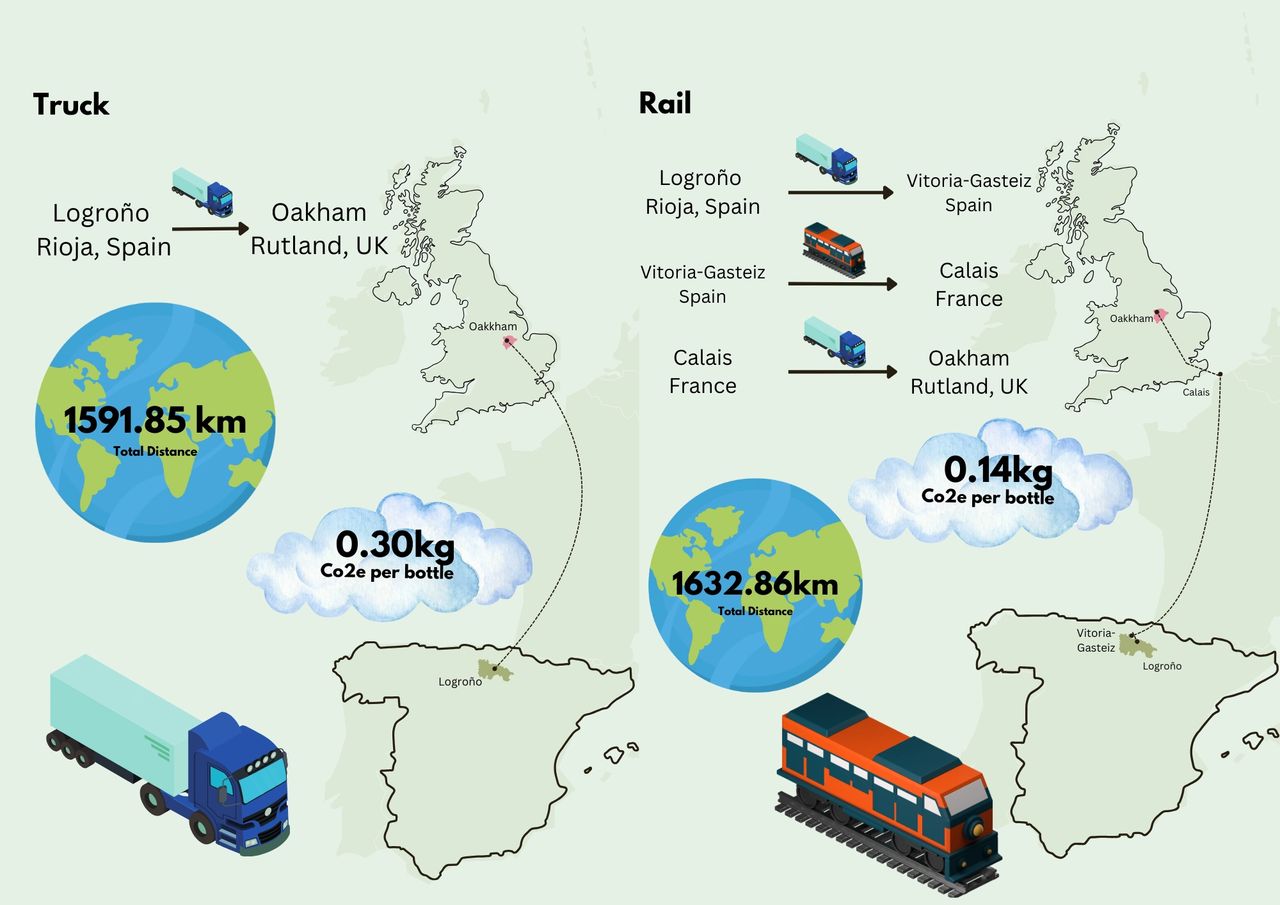
Figure 1 illustrates that despite the slightly longer distance of 1632.9km for rail compared to 1591.85km for road, rail produces significantly lower carbon emissions per bottle at 0.14kg Co2e vs 0.30kg Co2e for road. Both route emissions have been calculated assuming the modes are using diesel fuel for consistency. The amount of electrification of the railways across Europe varies depending on the country. Alternative fuels such as Compressed Natural Gas (CNG), Liquefied Petroleum Gas (LPG), and Liquefied Natural Gas (LNG) as well as electricity are options for trucks. However, not many are using these alternatives. For example, over 96% of new truck sales in 2022 in the EU were made up of diesel-fuelled trucks. With the limited presence in the market of alternatives to diesel, there is very little option for immediate ways to reduce emissions with trucks, leaving rail as a better alternative even if it is on a diesel rail corridor. Beyond fuel types, several other factors can play a role in the overall picture, such as ensuring route feasibility on rail with different freight corridors and gauges in different areas. Yet, despite the need to change modes and the need for careful planning with rail, it is the more environmentally friendly option. If you can go with rail.
Sea Routes - Watch out for RoRo
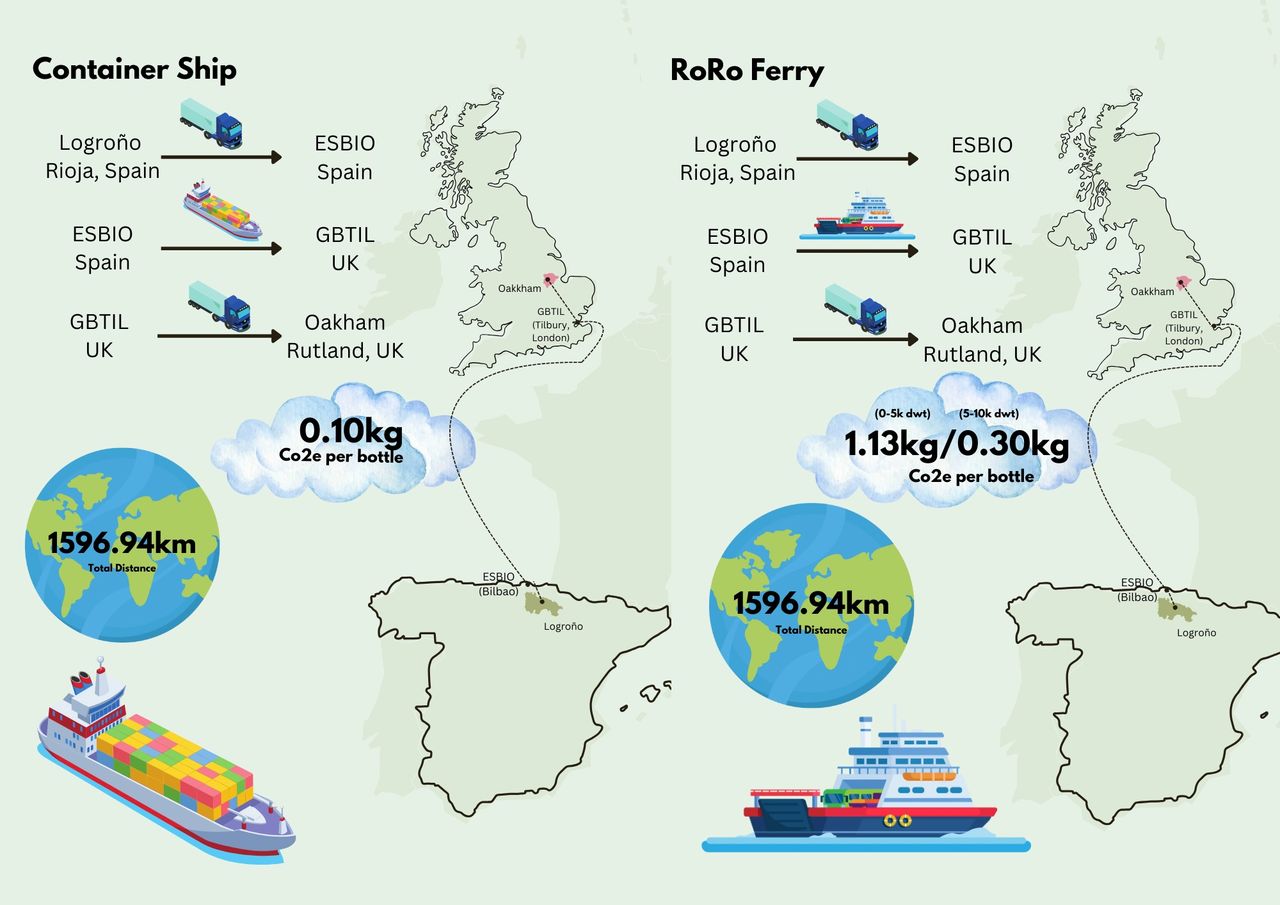
Container shipping is the most environmentally friendly transportation method amongst those evaluated with emissions of just 0.10kg Co2e per bottle. The efficiency of cargo ships with their ability to transport thousands of tons of goods at once is a significant contributor to this low emission rate, due to the distribution of emissions across a large volume of freight. RoRo is an alternative sea option allowing vehicles or containers to be driven/rolled on and off of ferries without the need for lifting on and off the ship. This generally provides a much more streamlined process with reduced handling at the port and waiting for loading and unloading. This whilst generally considered to be a more efficient route, is however considerably more environmentally costly if the RoRo's deadweight tonnage (dwt) is on the smaller side. I.e. 0-5k dwt. We acknowledge that from the Port of Bilbao the direct service to Tilbury is a Co-Ro service which is a combination of RoRo and Container ship. For the purposes of this analysis, we felt it best to be able to show a direct comparison of departing and arriving at the same ports. Emissions for a RoRo taking the same sea journey from Bilbao to London Tilbury would be over 1000% more costly at 1.13kg Co2e per bottle if the RoRo is 0-5k dwt. Increasing the deadweight tonnage to 5-10k dwt does decrease the carbon considerably to 0.30kg Co2e per bottle. However, this is still not as low as a container ship. Moving to sea routes is a valid choice for those looking to reduce the carbon emissions for their wine transportation but the mode choice is incredibly important. Watch out for RoRo, particularly the smaller ones.
Air Routes - Try to Avoid
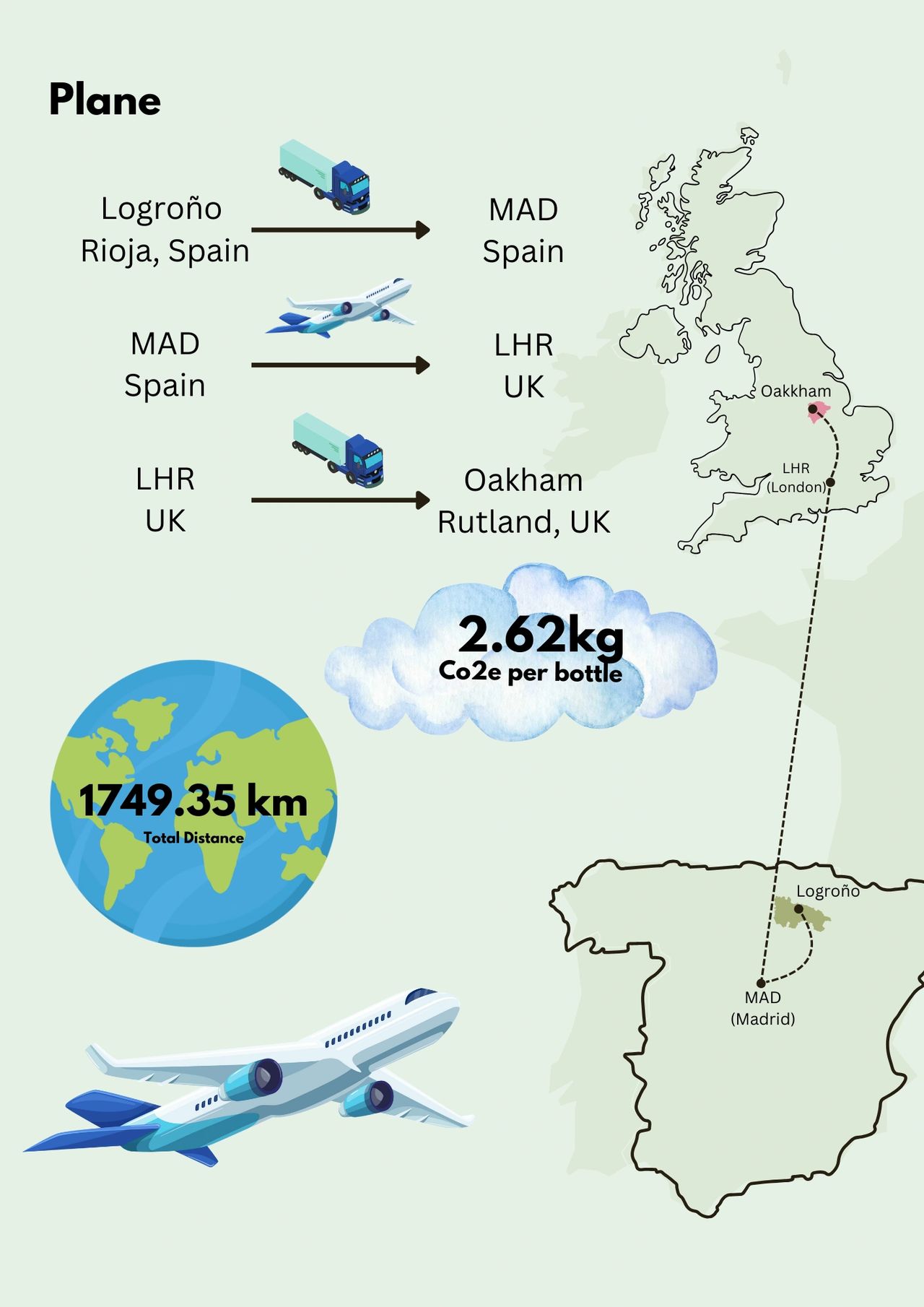
Whilst using a plane to move Rioja to the UK does provide large efficiency gains, transporting goods within hours rather than days or weeks between the two locations, does come at a considerable environmental cost. It is by far the most carbon-intensive of all analysed routes emitting 2.62kg Co2e per bottle. Data would suggest that UK Rioja importers are already choosing to use alternatives to flying with only the highest-value wine being transported in this manner. In fact, only 3kg worth of Rioja (In 2l bottles or less) has been imported into the UK in the first half of 2024 via customs at an airport. For those focused on minimising carbon emissions, air transport should be seen as the last resort due to its extremely high carbon emissions compared to available alternatives by road, rail and sea.
Summary
For those who prefer to skip to the summary, here's what you need to know from Part 1.
On our analysed routes for transporting wine from Rioja, Spain to Rutland, UK, container ships and trains are the best options to minimise carbon emissions. Trucks are not ideal due to the large amount of diesel with limited alternatives unfortunately unlikely to be viable in reality. However, it is acknowledged that they are of course necessary for the first and final mile. RoRo Ferries have higher emissions than you would initially expect, particularly the smaller ones, so watch out for those. As for planes - avoid them if you can. Simple, yes?
Unfortunately, such framing is oversimplified. Like many things, the reality is more complex and even more so when you're optimising your overall supply chain. In other words, you would want to optimise with emissions in mind, rather than optimising for emissions alone. So what does this mean for your route selections?
In Part 2, these complexities will be explored in greater depth focusing on two key areas:
1. Carbon variables: Such as weather and route conditions, port emissions, speed and packaging strategies
2. Business priorities affecting route choices: Such as cost, efficiency, supply & demand, and security.
.svg)
.svg)
.webp)
.webp)